



Othello news
How Many Moves Ahead do I Need to Calculate to Play Othello Well?
24 January 2026Written by Carlo Affatigato
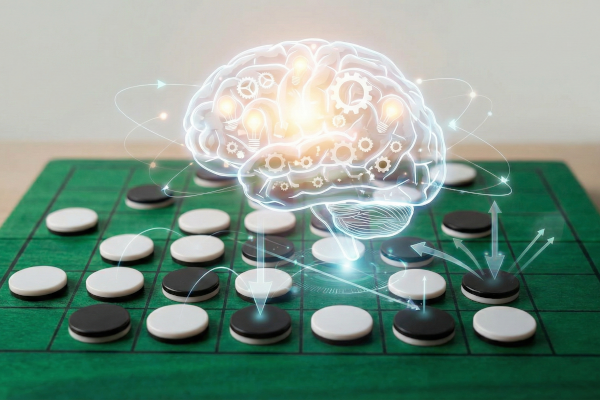
SPOILER: THE ANSWER IS NOT A NUMBER
Back when I was young and naive, still poring over books to improve my chess game, I came across that famous quote by the Czechoslovakian Grandmaster Richard Réti. When asked how many moves he typically calculated during a match, he would reply: "As a rule, not a single one." He was always careful to emphasize that he was being entirely sincere. That answer carried a very specific meaning: it served to highlight that raw prediction is not the only way to play well—nor is it necessarily the most important. Instead, it points to other approaches we humans use to excel in complex games like chess, Othello, or Go.
The Artist and The Engineer
Focusing our attention on our predictive capabilities—the ability to see the board ahead in time—is a perfectly valid pursuit. This is especially true in modern times, as we witness computers and artificial intelligences excel at the games we love through their sheer raw computing power. The truth, however, is that there are two possible thinking methods to use when we evaluate the best move in Othello (or any other complex abstract game):
- The Positional Approach: This analyzes patterns and the relative strengths of the position on the board. It identifies one or more good moves that aim primarily to create a position which "feels" solid or, at the very least, provides us with a sense of confidence.
- The Predictive Approach: This involves a separate evaluation of various possible moves. For each one, the player carries out the sequence 'in their mind,' anticipating the opponent's responses, exploring decision trees of varying depths, and often counting the discs gained as the analysis progresses.
In some ways, these can be seen as the classic distinction between playing by 'instinct' versus 'reasoning.' In the gaming world, they are often labeled as the 'romantic/artistic' style versus the 'analytical/engineering' style. Game theory calls the former 'heuristics,' as opposed to exhaustive analysis. Daniel Kahneman would likely reach for his book Thinking Fast and Slow and scream "hey, this is what I called 'System 1 and System 2' thinking!". All are valid and complementary ways of saying the same thing.
"If I Were a Computer..."
Both approaches achieve their goal, and when refined, lead to consistently good results. The predictive approach, however, is extremely challenging in terms of mental energy: it consumes resources on a massive scale and can lead us into a state of exhaustion that is difficult to recover from quickly. This is why we frequently fall back on the positional approach, which in its purest sense is an 'absence of reasoning': the brain provides an immediate response without conscious thought — a result of patterns recognized from past experiences, sequences seen in similar cases, or (to touch on a hot topic of the moment) lines memorized during study (memory doesn't use computational power). The more tired we are, the more easily our brain defaults to the positional approach. The risk, however, is that a purely positional view can hide pitfalls that aren't immediately visible—unexpected responses or traps that an opponent can spring to turn the game in their favor.
If we were computers, we would do nothing but use the predictive approach for every single move, pushing our brains as far as possible every time it was our turn. This would be equivalent to calculating exactly how many degrees to turn the steering wheel before approaching every curve: not only humanly impossible, but completely ineffective in terms of the effort-to-result ratio. Being human, we are better than computers at something else: "eyeballing" a situation, obtaining a general sense of a move's value almost instantly, albeit with a certain margin of error. A computer might say: "If I were human, I’d avoid brute-forcing every branch of the decision tree and would prune half the nonsensical moves right away using 'instinct' — but alas, I have no instinct!" While we sweat blood to improve our analytical skills, computers would trade half their computational power for our 'artistic/romantic' abilities and our capacity for immediate evaluation.
The Glucose Gambit: It's a Very Very Risky World
By now, it should be clear where I’m going with this article, which starts with a question and spends three-quarters of the text doing everything to avoid answering it.
The point is: reducing our skill at Othello to a simple numerical measure of the moves we predict is both misleading and counterproductive. "Playing Othello well" means finding the ideal mix between the analytical and positional approaches. It’s not so much about how many moves we can predict, but how good we are at determining when it’s time to calculate and when it’s better to save our energy and trust our positional vision. The experience of great players allows them to recognize, better than anyone else, exactly when to stop and reason, knowing how much room they can afford to give to the calculation phase. The positional approach serves to prune the possibilities that require deeper analytical scrutiny; expert players are simply those who have found a better balance between the two.
The greater the experience, the easier it is to recognize when a position carries the risk of a superficial analysis. Experience also helps limit the 'directions' the analysis takes and teaches us when it’s okay to stop the predictive process. Playing Othello is always a battle against time, as well as against our own computational limits. Therefore, true talent isn't the number of moves we can calculate, but knowing when to dive deep and when to pull back. It’s a fascinating mix of emotional management, preparation, and knowledge of one’s own limits and strengths. Improving at Othello doesn't necessarily mean increasing the depth of our evaluations; it means being able to identify with greater precision when an analysis is sufficient, when it’s excessive, and when it’s lacking. It’s about establishing the best approach in terms of the risk of making a losing move, the risk of running out of time, and the risk of depleting the glucose circulating in our bodies.
In short, it’s a world full of risks, and navigating it is practically impossible. 'Experienced' players are often better than us at Othello, but understanding exactly why they are better isn't easy (and if you ask them, they often won't know what to tell you). So, we are left to study, explore our limits and the quirks of human reasoning, try different approaches to test their validity, and... play, play, and play some more. Because when it comes to accumulating experience, you can never go wrong.