




Othello news
What should I eat during an Othello tournament?
29 April 2026Written by Carlo Affatigato
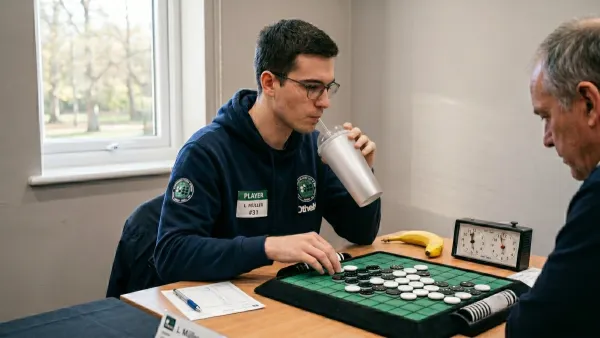
I know exactly what you’re up to the moment my back is turned. You’ve probably caught me at tournaments looking... let’s say, eccentric. You’ve seen me fussing over jars of jam and mysterious juice bottles, and you’ve definitely heard me preaching to anyone within earshot about what you absolutely should not touch for lunch. I can practically hear your inner monologue: "An article on tournament diet, really? What are you now, a nutritionist?"
No, I’m definitely not a food or sports expert. I’m just a guy who’s done a lot of trial and error over the years, tournament after tournament, until I finally cracked the "champions’ formula" (That’s not just a fancy title, it’s literally what I tell my kids every day when they’re hunting for snacks). And since I love writing for the fun of it, and I'm not the type to wait until I have the Holy Grail of knowledge before sharing, here’s an article you probably didn’t ask for, but might actually enjoy. Think of it as some food for thought—pun intended—on the ideal diet for a mental sports tournament.
And hey, if there is a real nutritionist among us, now’s your chance to jump in and set me straight.
Wait, does nutrition actually matter for concentration?
It’s not just important; it’s everything.
In fact, I’d bet my last disk that over half of your tournament performance comes down to what you put on your plate.
Honestly, this shouldn't even be shocking. We like to get romantic and think of ourselves as mysterious, high-functioning beings capable of deep thoughts and complex calculations. But let’s get real: we’re energy-guzzling machines that turn calories into organ function. To most people, it feels weird to link abstract things like emotions or math skills to boring old biology. But then you get into psychology, you read a bit of Robert Sapolsky, and you realize his top tips for fighting off depression, burnouts and intrusive thoughts are dead simple: eat healthy and get moving.
It makes total sense, though. Othello, chess, or math competitions—they’re all sports. To win, your brain needs to be firing on all cylinders. We have to treat the brain like what it is: an organ. Plenty of us in the Othello world are into jogging and running marathons. We easily see the link there: the self-challenge, the limit-pushing... but nobody shows up to a marathon without training their legs and meticulously planning their meals.
Othello is no different. We spend months practicing and studying; we need to back that up with the right fuel. Otherwise, it’s like eating a giant plate of lasagna and expecting to run 40 kilometers.
So, pizza for lunch at the next tournament?
Every time you’ve felt your concentration slip in the afternoon or on the second day of a tournament, there’s a good chance your breakfast or lunch was to blame. While a marathon runner’s biggest enemy is running out of physical steam, in Othello, the #1 danger is the glycemic drop.
To perform at its peak, the brain is desperate for hydration and glucose. It needs them even on a regular day, and it starts to malfunction the moment it runs low. Think about those mood swings you get when you’re "hangry," or the way kids have a meltdown after school because they haven’t snacked in two hours. That’s just the brain running out of fuel—the prefrontal cortex literally crying for help. And that’s how your brain acts during a normal day: imagine what happens when you force it to run a "mental marathon," focusing for eight straight hours in a tournament.
So, should I just eat sugar and carbs all day to stay fueled?
That’s even worse: you’re just creating the perfect conditions for a massive sugar crash.
Mental engineering and that dreaded glucose curve
Time for a bit of geometry. Let’s talk Cartesian axes. This is what happens to the glucose in your body when you eat standard bread, pasta, or rice—your classic carbohydrates.
It is pretty much what we’d expect: we eat, glucose levels rise, they hit a peak after about an hour, and after two hours, they settle back to where they started. This is the typical rhythm between meals during a normal day of regular mental activity.
Now, let’s see what happens (still under normal conditions) if we toss a sugary snack into the mix.
The first difference is that the peak is much higher: we’ve sent a literal flood of glucose into our system in just thirty minutes. In response, our pancreas starts pumping out terrifying amounts of insulin to absorb that sugar as fast as possible. An hour after the snack, there is so much insulin circulating that even after the "glucose emergency" has passed, it just keeps absorbing indiscriminately. So, you grabbed that snack to "give yourself a boost," but two hours later, you're actually in worse shape than before. That is the famous sugar crash we so often underestimate.
In other words, all those sweets and biscuits in the room next to the tournament hall at EGP Lucca 2025? Nothing but a diabolical plot by the Italian Federation to sabotage your performance right before the finals.
The Othello Marathon
Everything we’ve talked about so far describes what happens during your standard, everyday brain activity. But what about when we’re sitting there for hours, literally squeezing our grey matter dry during an Othello tournament? Let’s look at what happens to your glucose levels when you eat simple carbs like bread or pizza while competing.
Wait... more glucose than before, even though I ate the same thing? Yup. And there’s a very specific reason for it: tournament adrenaline. It kicks your liver into gear, forcing it to burn through those stored glycogen reserves and pumping even more fuel into your brain.
However, your brain isn't exactly taking a leisurely stroll by the lake. It’s sprinting uphill at full speed for an hour. You’re burning through that glucose at a terrifying rate, which makes the post-meal crash even more of a nightmare—pretty much identical to the sugar crash you get from those "sabotage" cookies.
And there's more: if you grab a pizza for lunch, you’re also kicking off a massive, energy-draining digestion process. Your body starts diverting blood flow away from your brain and straight toward your stomach. Digestion is actually one of the most taxing activities the human body can perform. So, while your prefrontal cortex is screaming for a fresh supply of glucose-rich blood, you’ve basically pulled the handbrake on your car while it's trying to climb a steep hill, all because you just had to have that ham and mushroom pizza. No wonder those final matches of the day often feel like you're playing through a fog.
At this point, it sounds like a puzzle with no solution. And honestly? In some ways, it is. But there is actually quite a bit we can do to put ourselves in a much better position to win.
The Champion’s Diet
The secret lies in complex carbohydrates paired with a solid serving of proteins and fats. Unlike the simple stuff, complex carbs—think whole-grain pasta, bread, or cereals—take much longer to break down, which stretches out that glycemic curve. And when you throw fats and proteins into the mix, your digestive system slows down even further, giving that blood sugar curve some serious "stamina."
Take a look at that top curve: that is the Holy Grail of brain performance. It’s a steady, reliable level of blood glucose that lasts for hours. Get your breakfast right, and your mind feels fantastic right through the middle of the day.
Of course, if your idea of a "fantastic day" involves an Othello tournament, things get a bit more complicated. We’re back to the car sprinting uphill; your brain is burning through that glucose at an incredible rate. Even so, you’re in much better shape: while you’d be in trouble after two hours on a standard diet, this mix keeps you at a "normal" level much longer.
But for those of us who want to win the World Championship, "normal" isn’t enough. We need to keep the brain flooded with fuel to spot the traps our opponents miss. So, while the complex carb/fat/protein combo is the best starting line, we need one more trick to get us through the final stretch—and that’s something we put into practice while we’re actually sitting at the board.
Enough theory. Let’s talk about real-world experience. At least mine: here is exactly how I eat when I’m competing in an Othello tournament.
A Day at the Othello Races
I wake up in the morning, ideally after a solid 7 or 8 hours of uninterrupted sleep. Then, I whip up the breakfast of champions: oats (whole grain is best) mixed with Greek yogurt and honey. This is the perfect trifecta of complex carbs, proteins, and fats. There are other combinations, of course, but since this energy-packed bowl hits the spot for me, I don’t need anything else. Don’t be shy with the portions—this is your engine starting up. We are building the foundation for peak performance for the rest of the day.
Like most of you, I need my coffee, but on tournament day, I take it strictly without sugar. This is even more vital for those coffees consumed right before a round. Today, added sugars are Public Enemy Number One; I’m not looking for a "crash." I’ve already got the honey in my breakfast, and that’s more than enough fuel.
One hour before the tournament kicks off, I eat a banana. It’s the classic marathon runner’s trick: more complex carbs and natural sugars to help "shift into gear" before the clock starts ticking.
I usually make sure to arrive at the venue after a 30-minute walk. Maybe I park a little further away, or I get off the metro a few stops early. This oxygenates the body, keeps the "digestive slump" at bay, and makes the brain much more sensitive to the glucose it’s about to receive.
Maintaining the Machine
The tournament begins, and the "uphill climb" starts trying to sabotage all my careful prep by burning through my glucose reserves. To stay sharp, I constantly sip my personal formula: 2/3 water and 1/3 apple juice. Not pure juice—that would be too much sugar and would weigh down my digestion. It needs to be diluted. Our brains need a lot of hydration on days like this, anyway. I prep a liter of this mix in the morning and take a sip almost every move. Usually, one liter is plenty to get through seven hour-long rounds.
At the end of the second round (mid-morning) and again around the fifth or sixth round (mid-afternoon), I have two or three squares of dark chocolate (at least 85% cocoa). This acts as a little "reboot" for the second half of those sessions when the last meal feels like a distant memory.
The "No-Bread" Lunch Policy
At lunch: zero carbs, only proteins. If the waiter brings a basket of bread to the table, feel free to throw it back at them. Ideally, go for fish—it’s packed with Omega-3s, which are basically gold for your brain. If I’m still hungry after a salmon fillet, I’ll just order a second protein-based dish. Usually, one is enough because that "breakfast of champions" is still doing the heavy lifting. If I skip the second course, I’ll finish with another banana, and that’s that.
One sugarless espresso and the check, please. Then it’s back to the board for the afternoon rounds, armed with my water-juice mix and those last few squares of dark chocolate.
In the end, it looks something like this.
The "Champion's Breakfast" kicks everything off perfectly. Those sips of the water-juice mix create those little "ripples" on the graph—constant micro-boosts that help you go the distance. Skipping the carbs at lunch prevents a major crash, and the bananas and dark chocolate handle the rest.
By the end of the day, I actually feel good. I don’t get that "totally wiped out" feeling I used to have; I finish the tournament feeling pretty much normal. It’s like I’ve been sprinting uphill all day, but I don’t really feel the fatigue.
This is what works for me. Feel free to experiment and find what fits you best—we can chat about it at the next tournament. Human biology is mostly the same for everyone, but we’re all unique enough that you might discover your own secret tweaks.
Of course, you’re always free to keep giving my "magic" tournament bottle suspicious looks while you happily tuck into a big plate of pasta for lunch. Then I hope I’m the one sitting across from you during round six!