




Othello news
Tilt Queuing: Why Can’t We Stop Playing When We Play Badly?
27 May 2026Written by Carlo Affatigato
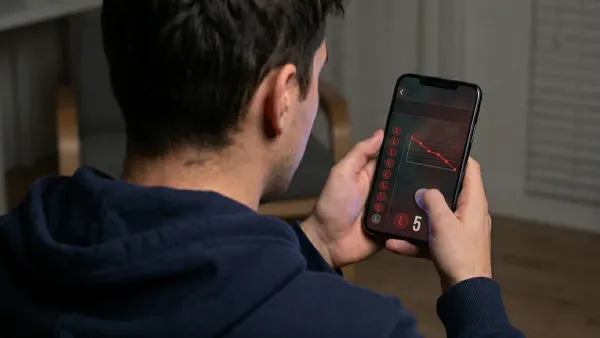
You know those days when a couple of online games go completely sideways, leaving you with that deep frustration and a desperate urge to make things right? You end up trapped in an endless loop of rapid-fire matches where, obviously, you’re playing without a shred of focus, ending up burning through 100 to 150 points of your online rating. Sometimes this phase drags on for days: you wake up the next morning with a bitter taste in your mouth and a craving for revenge, and if those first few games go poorly again (maybe because you barely slept after the mental exhaustion of the previous day), the losing streak restarts.
It’s happened to all of us at least once. In reality, it’s a pretty well-known phenomenon, especially in the world of online gaming. It’s called tilt queuing, and it is the hidden byproduct of a very specific mental state we slip into in those moments.
The Glitch in Our Brain: What Happens When Things Go Wrong
You take a quick break and queue up for an online game. The match ends, and you’re completely unsatisfied: for some reason, you missed something you absolutely should have seen, or the game just fell apart into a desperate mess without any clear reason. If your mind is sharp, you can just shrug it off and refuse to let a single loss drag you down. But then maybe you play two more, and as luck would have it, the cycle repeats.
After a while, staying clear-headed becomes impossible. It’s pure biology: your body is heading straight into what is scientifically known as a dopamine crash. Your dopamine levels plummet, and your mind goes into a panic. We’ve just experienced a massive wave of dissatisfaction, and our brain now feels an urgent need to find something (anything!) that will give us an immediate spike to help us forget what happened. And since we’re probably using one of those gaming apps with automatic matchmaking, it’s pure instinct to hit "play again" a second later, hoping our luck will turn.
For many, the frustration comes simply from watching their online rating tank. For others (and I personally fall into this camp), the rating doesn’t matter all that much: the real issue is the necessity of finding your brilliance again. You feel this desperate need to hit that one game that ends with the feeling that you’ve rediscovered "your touch." But you can already see the problem here: we are chasing a satisfying performance at the exact moment our brain has completely lost its focus. Because—Murphy’s Law—by the time we are twenty matches deep into tilt queueing, our actual capacity to concentrate is completely shot. Another direct side effect of the dopamine crash.
The result is that we end up playing that long streak of games using only one half of our reasoning. Remember when we talked about the two mental approaches we use when playing Othello? We labeled them the "positional approach" and the "predictive approach," which are really just the difference between "playing on instinct" and "calculating every single continuation with the maximum depth we are capable of." Well, when we are tilt queueing, our calculating half is completely gone. We are playing purely based on memory, patterns, and instinctive moves—which is basically our default autopilot gameplay when the brain isn’t in the right condition for complex thoughts.
There is a deep irony in all of this: when we play well and feel satisfied, we typically stop after one or two games, meaning that when our rating goes up, it climbs very slowly. But when we play badly... that’s when we end up playing 40 games straight, right during our absolute worst mental state. And weeks of progress get wiped out in a couple of hours.
It Could Have Been Much Worse: Some Good News
The phenomenon of tilt queueing is so common that online gaming communities have been discussing it for years. In the chess world, for instance, Chessbio tried to break down the phenomenon in this article, offering tips on how to keep it from happening. On the internet, there is also plenty of video content or Reddit threads dedicated to the topic.
But looking past the immediate frustration, is tilt queueing really that catastrophic? Honestly, there’s no need to be so dramatic. First of all, there’s a massive reason to be grateful: this exact same psychological trap happens—much more frequently, in fact—in gambling circles like poker, and when it strikes there, it’s incredibly easy to lose a fortune. Anyone with a bit of experience in the world of finance and investing has probably noticed it happens there too: if you hit a bad investment, you get hit with this sudden, powerful urge to find an immediate alternative to make "big money fast" and recoup your losses. But as you can imagine, that is the absolute perfect mindset for getting sucked into even worse investments. In both cases, whether in poker or when investing your hard-earned savings, acting while your mind is on tilt risks ruining you. In Othello, the absolute worst thing that can happen to you is losing 200 rating points in a single day. And ratings don't really mean anything, right?
Beyond that, there’s another aspect worth highlighting that can genuinely cheer us up. When we play all those games while our brain is stuck in default mode, we are actually "testing our floor."
In the spectrum of mental clarity we can bring to a game of Othello, the absolute highest peak—the ceiling—is what we bring to life during our best tournaments, maybe after we’ve engineered our nutrition to absolute perfection, right? Well, the very bottom of that range is the "instant, gut-reaction gameplay" we fall back on when we tilt queue. And to be perfectly honest, lifting our floor is just as important—if not more so—than refining our ceiling. In some ways, it can be even more effective: our ceiling actually faces a hard limit dictated by our natural talent, whereas our floor has massive room for upward growth.
Refining Our Instinct
Okay, but what does it actually mean to improve your floor? It means expanding the toolkit we rely on when our brain is physically incapable of deep, complex thinking. In Othello, this comes down to two main things: memorized sequences and pattern recognition.
When you play 50 (or 200) games straight in full tilt queue mode, you are actually accumulating an immense mountain of case studies to refine those two exact skills. We can make great use of those painful sessions where our rating plummets tragically: we can review every single one of those losses to see, for example, just how early we fell out of book, and spend a few minutes trying to expand our memorized openings. That way, next time, we’ll be able to play one or two more good moves without having to resort to heavy, exhausting hard thinking. The same goes for pattern recognition: often, the right move in the midgame or endgame can be found through "typical sequences" that apply to very specific structures or areas of the board. When our capacity for deep calculation is totally drained, it would be incredibly helpful if those moves simply jumped out at our eyes by pure instinct. Obviously, building that takes years, but raw experience helps: by analyzing the moves our instinct missed during those exhausted moments, we can gradually sharpen it.
In short, if you’ve just spent the last six hours of your life locked in a rage-replay bender and still haven’t found that single satisfying win to lift your spirits, look on the bright side: you have the perfect opportunity to spend a few extra minutes studying your mistakes, boosting the strength of your play style for the next time you’re running on pure autopilot.
The Beauty of Being Human
In the end, it all blows over. Sooner or later, our rating will climb back to where it used to be, we’ll go back to feeling proud of the level we’ve achieved, and this temporary moment of darkness will fade away without having cost us thousands of dollars. Being fully aware of how our minds work helps remind us that what we’re experiencing is completely normal, and it’s deeply useful for finding our balance again just a little bit faster.
Sure, maybe we only reach that realization after sleeping for a grand total of four hours, or after completely snapping at our kid for leaving a breakfast mug out of place. But at the end of the day, we are only human—and we also play Othello to put our human limits to the test.